Wednesday, October 21, 2009

Second Harvest Update

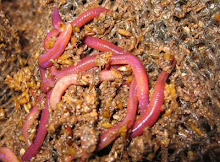
Vermicast-enriched pakalana.


An update on how the second harvest is being used:

E., my friend and Hogwarts Garden overseer, used her vermicast to fertilize a bed of winter squash; said squash will be used in soup a few weeks from now. Can't wait to see the happy results. And L. will be using hers to feed her roses. M. and I have spread our bounty throughout our backyard garden: the pakalana plants, in particular, seem to be thriving, and our banana trees are issuing fruit. A few tomato plants have also unexpectedly sprung from the vermicast; suspect they're the scions of some overripe grape tomatoes one of my freshmen had fed to the worms over a year ago. Amazing to think that the seeds still remain viable after so long and after worm processing. But in our case, the renegade tomatoes are a welcome addition, making for a merrier garden, so we've let them be, in the hope of reaping future rewards.

Monday, October 5, 2009

Vermicast: Second Harvest

The finished product, ready for use.


Harvested the second batch of vermicast this afternoon: moist, dark, and rich. This time, for whatever reason, there thankfully were not as many worms present in the tray as the last time--a good thing--though I left the lid uncovered and exposed to sunlight for a few hours, allowing any worms still lingering in the tray to wend their way downwards to what will be the working trays.

The harvest will be split amongst some gardener friends in the English Department, as well as donated to the Academy Garden growing behind Griffiths, a sustainability project spearheaded by my friend, E. I'm quite excited at the prospect of helping fertilize the lush basil, sunflowers, and taro that are currently growing there.

Tuesday, March 31, 2009

At long last: vermicast!

Harvested my first batch of vermicast yesterday afternoon. After spreading layers of newspapers to catch any moisture, I removed the heavy tiers one by one, laying them on the ground. Surprisingly, the contents of the second working tray almost looked ready to harvest as well: fine, dark, and moist, almost like a chocolate cake.

More worms were cruising the bottom tray than I anticipated, though the vermicast itself was perfectly decomposed, black as espresso grounds, save for tiny flecks of brown organic eggshells I'd added a year ago to the bin, and near-odorless, save for the faintest wisp of rainforest scent. Fortunately, though the weather was sunny, there was no light directly shining on the composter, so I placed the finished tray on the top of the bin, and left it uncovered, trusting that the worms, true to form, would skedaddle into the subterranean depths to avoid the sunlight. Sure enough, in an hour or so, I was able to scoop the finished vermicast into a sturdy plastic bin with handles, donated to the cause by my friend, S, without much incident--though I did find two stowaways this morning in the finished vermicast, who're currently residing in the scrap jar in my office, awaiting return to the composter.

Friday, March 6, 2009

Coming Into the Home Stretch

Since it's been nearly eight months since my last post, I thought I'd give an update on the status of our bin. In September, we moved it out to the lanai of the building to avoid any unfortunate leachate leakage. At first, sun exposure was evaporating all the leachate--not necessarily a bad thing, as it makes for much easier maintenance if one doesn't have to drain out the moisture as often--but lately, I've had to drain quite a bit of liquid on a weekly basis, due to the generally cool and inclement weather of the past few months. Yesterday, I provided several containers worth to my fellow teacher, E., who has started up an Academy garden in conjunction with her "Nature" English elective. As of yet, the garden still lies fallow, as volunteers turned over the soil and mulched it just a few weeks ago; actual planting will not begin until May. The leachate will be used to supplement that garden as well as the kindergarten garden, so while we're still awaiting "black gold", our bin is still providing something useful to the larger school community.

The worms are thriving: I've watched several generations hatch from eggs, and when the protective layers of damp newspaper are moved in order to add food and circulate the organic matter, one sees a number of them squiggling into the subterranean depths, no doubt perturbed at the interruption of their slow, yet steady glutting. Unfortunately, the outdoor locale has also attracted less desirable life, namely outdoor cockroaches and ants, though I suppose I shouldn't be disparaging of the latter: after all, they too are decomposers and therefore, are serving a valuable function, even if they are loathsome...

I'm thinking about holding a (vermi)cast party and getting interested volunteers from the Hogwarts Community to help harvest the goods. Regardless of whether the party logistics come to fruition, however, I'm relishing the prospect of symbolically gifting the first vermicast so it fertilizes many gardens: those at the one at the Center for Public Service, the homes of faculty and staff, and our school.

Monday, July 21, 2008

The Third Tray is On!

The third, and final, tray was added to our Can-O-Worms on July 27, 2008. This layer requires no worm bedding, as the worms reside in the lower layers, and show up in the topmost tray only at mealtimes. In approximately 3 months or so, we should have our first vermicast harvest. Stay tuned.

Thursday, June 5, 2008

The Adventures of Herman, the Squirmin' Worm


"The Adventures of Herman: The Autobiography of Squirmin' Herman the Worm", a kid-friendly, educational, and cute website, comes courtesy of the University of Illinois at Urbana-Champaign Extension Urban Programs Research Network. The site offers a brief history of vermicomposting in America, offers instructions on creating and maintaining a worm bin, and reviews essential information on worm anatomy, feeding, and reproduction, as well as an overview of worm bin environs.

Some wild facts about worms: First: they're hermaphroditic! Mature worms have both male and female reproductive parts located in their clitellum, a light-colored, swollen, ring. When worms mate, they join, with their heads pointing in opposite directions. They exchange sperm, which is stored in sacs, and cocoons form on the clitellum of each worm. As the worms back out of the cocoons, they deposit sperm and eggs into the cocoons. Once the cocoons close, fertilization takes place. Cocoons can be produced on the order of once a week. Each cocoon holds 1-5 worms and can lie dormant until ideal (read: moist) conditions emerge: they take 2-3 weeks to hatch.

Worms have five hearts, and since they have no lungs, oxygen diffuses across their moist skin, moving from the area of higher concentration (the air) to the area of lower concentration (inside the worm). This is why it's essential not to feed the worms oily food, as it interferes in absorption.

Worms have small mouths, located in the first anterior segment, hence can only feed on small things: bacteria, fungi, protozoa, and organic material. A flap, located near the mouth, called the prostomium helps keep unwanted particles out. Since they have no teeth to break down their food, an organ called a gizzard does the work. Some worm sites suggest adding garden lime, eggshells, or sand to aid the worm in grinding down the food. When the gizzard contracts, the small grains and grit inside of it compress against the food, grinding it into digestible particles that subsequently enter the intestine. There, digestive enzymes break down the nutrients, which pass through the intestinal wall and are absorbed in the bloodstream. Undigested waste material passes through the anus as vermicast.

To some extent, worms can regenerate: if their posterior (tail) end is severed, they can grow a new tail, but the same cannot be said if their anterior (head) is lopped off.

Wednesday, June 4, 2008

Tea, m'dear?


When you examine vermicomposting sites on the Internet,there seems to be a great deal of confusion regarding what one calls the dark brown liquid that's produced as a by-product of the worm bin, and which must periodically be drained from the side spigot.

This liquid is properly called leachate, which the Oxford English Dictionary On-line defines as "(A quantity of) liquid that has percolated through a solid and leached (extracted) out some of the constituents." The University of Hawaii's College of Tropical Agriculture and Human Resources (UH-CTAHR), in their August 2005 publication HG-45, "Small-Scale Vermicomposting" (Selden, DuPonte, et al) notes that leachate may "have a slight odor" and "can be used full-strength or mixed with water. Use it to water plants or dispose of it on your compost pile." S. Zorba Frankel, in "Compost Tea or Leachate" from Worm Digest #22, however, warns that watering with leachate might not, be good for plants: "When a liquid seeps through a material containing decomposing organic matter, some of that organic matter is carried along in the water. When it leaves the system, carrying with it undecomposed organic matter, we call it leachate. Now, water does not allow enough oxygen to diffuse into it to support aerobic microorganisms, and so anaerobic micororganisms are encouraged. These anaerobes produce some undesirable byproducts that are not good for plants."

In contrast to leachate, "worm compost `tea' is made from finished compost and involves a separate process" (UH-CTAHR's HG-45). Vermicast tea, sometimes known as worm tea, is a suspension made by soaking finished castings in water. The resulting "tea" can be used either as liquid fertilizer to water plants, or as a topical foliar application.

Here's a simple vermicast tea recipe, from tcdutch at the GardenWeb vermicompost forum: "take two tablespoons vermicompost and add it to one quart of water. Let it steep for a day, mixing occasionally. Then add it to your plants or spray it on their leaves."

You can find a more complicated recipe for aerated compost tea at the Pennsylvania Department of Environmental Protection. They state that compost tea is a sustainable and safer alternative to chemical-based fertilizers, pesticides, and fungicides and offers the following benefits:

* Increases plant growth
* Provides nutrients to plants and soil
* Provides beneficial organisms
* Helps to supress diseases
* Replaces toxic garden chemicals

For added nutritive benefit, one can also add seaweed emulsion or fish emulsion, presumably for the extra nitrogen. Why aerate, you ask, when the 2T vermicast + 1 qt. H20 is so simple? Here's why: oxygenating the tea helps create aerobic conditions that reduce phytotoxins and phytopathogens, a.k.a. things which can damage and/or kill your plants.

While browsing articles on compost tea, I came across an NPR audio file and article on compost soup, from Ketzel Levine's series, Talking Plants.

To find out more about the science behind compost tea and how it does all of the above, check out this fascinating article by microbial ecologist, Elaine Ingham. Ingham underscores that compost tea enhances beneficial microorganisms in the soil foodweb, organisms that die when we pollute the air or use conventional fertilizers and pesticides to kill off harmful bacteria, protozoa, nematodes, and fungi.